

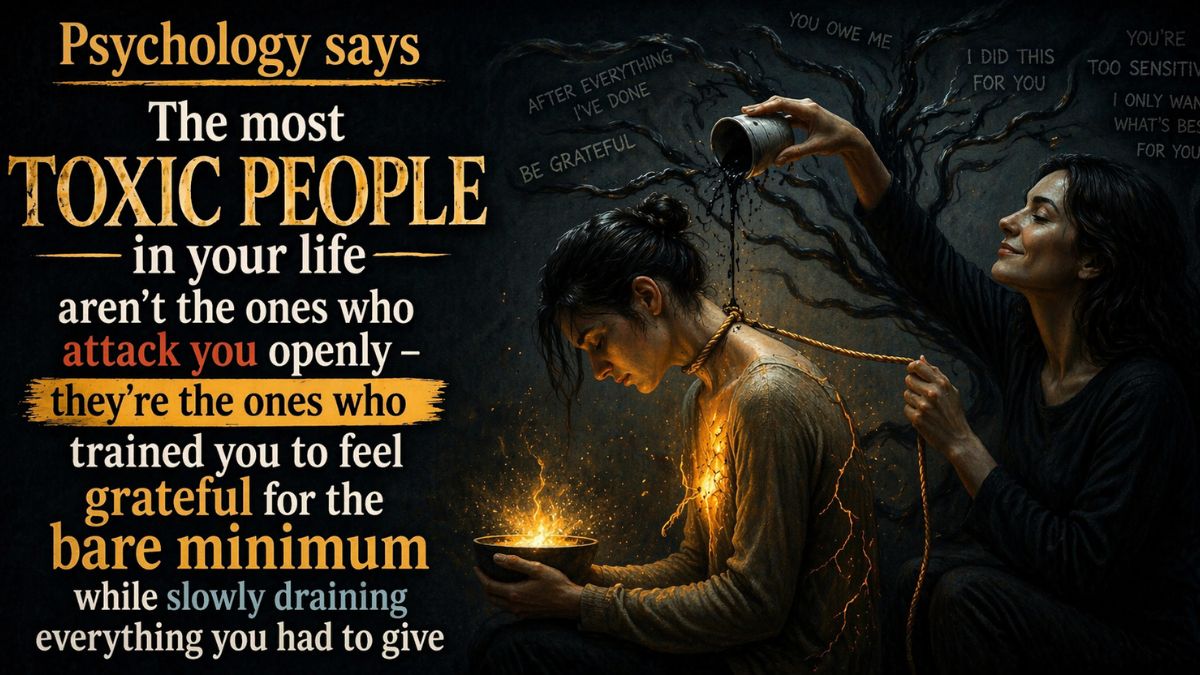
When we think of toxic people, most of us imagine loud, aggressive individuals—those who criticize openly, argue relentlessly, or display obvious hostility. These are the people we are taught to recognize and avoid. But psychology suggests something far more unsettling: the most toxic people in your life are often not the ones who attack you openly. Instead, they are the ones who subtly reshape your expectations, teaching you to feel grateful for less while quietly draining your emotional, mental, and even physical energy.
This kind of toxicity doesn’t announce itself. It doesn’t come with raised voices or dramatic confrontations. It hides in normalcy, in routine interactions, and in relationships that, on the surface, may even appear loving or supportive. That is precisely what makes it so dangerous.
The Subtle Nature of Emotional Manipulation
At the heart of this dynamic lies emotional manipulation—a slow and often invisible process. These individuals rarely demand everything from you all at once. Instead, they take a little at a time. They may offer just enough kindness, attention, or validation to keep you invested, while gradually lowering the standard of what you believe you deserve.
Over time, this creates a distorted emotional environment. You begin to measure love not by consistency or respect, but by moments of relief. When they show you even the smallest act of kindness, it feels significant—because it has become rare. You find yourself feeling grateful for things that should have been basic expectations all along.
This is how the cycle begins. Not through force, but through conditioning.
How You Are Trained to Accept Less
One of the most powerful aspects of this form of toxicity is how it trains you. You are not simply experiencing a difficult relationship—you are being reshaped by it.
It starts subtly. Maybe your efforts are rarely acknowledged, or your needs are dismissed as unimportant. When you express discomfort, you might be told you are overreacting. When you ask for more, you are made to feel demanding or ungrateful. Slowly, you begin to silence yourself.
Eventually, you stop expecting more altogether. You adjust your standards downward, convincing yourself that this is normal, or even that this is all you deserve. The bare minimum begins to feel like generosity, and anything beyond that feels like a bonus.
This psychological conditioning can be so deep that even when better treatment appears, it feels unfamiliar or undeserved.
The Illusion of Gratitude
Gratitude is often seen as a positive trait—something that brings peace and contentment. But in toxic dynamics, gratitude can be weaponized.
When someone consistently gives you less than you need, yet occasionally provides small gestures of care, those gestures take on exaggerated importance. You feel thankful not because your needs are being met, but because you have grown accustomed to their absence.
This creates an illusion. You begin to associate the relationship with moments of relief rather than consistent well-being. The occasional kindness becomes proof, in your mind, that the relationship is worth holding onto, even if the overall experience is draining.
In reality, what you are feeling is not true gratitude—it is a response to emotional deprivation.
The Slow Drain of Your Energy
Unlike overt toxicity, which can be exhausting in obvious ways, this kind of relationship drains you slowly and quietly. It doesn’t burn you out all at once—it wears you down over time.
You may find yourself constantly trying to earn approval or maintain harmony. You invest more energy, more patience, and more understanding, hoping that things will improve. But instead of feeling fulfilled, you feel depleted.
This happens because the balance is never equal. You are giving more than you are receiving, often without even realizing it. Your emotional reserves are being used up to sustain a dynamic that does not replenish you.
Over time, this can affect your confidence, your sense of identity, and your overall mental health. You may begin to feel tired without knowing exactly why, disconnected from yourself, or unsure of what you truly need.
Why It’s So Hard to Recognize
One of the most challenging aspects of this kind of toxicity is that it is difficult to identify. There are no clear boundaries being crossed in obvious ways. There are no dramatic moments that signal something is wrong.
Instead, everything exists in a gray area. The person may not seem intentionally harmful. They may have moments of kindness that make you question your own perceptions. You may even blame yourself, wondering if you are expecting too much.
This confusion is part of what keeps the cycle going. When harm is inconsistent and subtle, it becomes easier to rationalize. You tell yourself that things aren’t that bad, or that everyone has flaws.
But the impact remains, regardless of how it is justified.
The Psychological Impact on Self-Worth
Perhaps the most damaging effect of this dynamic is how it shapes your self-worth. When you are consistently given less than you deserve, and taught to be grateful for it, you begin to internalize that standard.
You start to believe that your needs are excessive, that your feelings are inconvenient, and that your value is tied to how much you can give rather than what you receive. This belief doesn’t stay confined to one relationship—it can extend into other areas of your life.
You may begin to accept less in friendships, in work environments, and even in your relationship with yourself. You may hesitate to set boundaries or ask for what you need, fearing rejection or conflict.
In this way, the impact of a toxic relationship can ripple far beyond the relationship itself.
Breaking the Pattern
Recognizing this pattern is the first and most important step toward breaking free from it. Awareness allows you to question the beliefs that have been shaped over time.
You begin to ask yourself important questions. Are your needs being consistently met? Do you feel valued and respected, or just occasionally acknowledged? Are you giving more than you are receiving?
These questions can be uncomfortable, especially if the answers challenge your current reality. But they are necessary for growth.
Breaking the pattern also involves rebuilding your sense of self-worth. This means redefining what you believe you deserve—not based on what you have been given, but on what is healthy and fair.
It requires learning to set boundaries, even when it feels difficult. It means allowing yourself to expect consistency, respect, and genuine care, rather than settling for occasional gestures.
Relearning What Healthy Feels Like
One of the most profound shifts in this journey is relearning what a healthy relationship feels like. When you have been conditioned to accept less, healthy dynamics can initially feel unfamiliar or even uncomfortable.
Consistency may feel unusual. Being heard without having to fight for attention may feel surprising. Receiving care without having to earn it may feel undeserved.
But over time, these experiences begin to reshape your expectations in a positive way. You start to recognize that you don’t have to prove your worth to receive basic respect and kindness.
Healthy relationships do not make you feel drained or uncertain. They do not require you to shrink yourself or lower your standards. Instead, they support your growth, respect your boundaries, and provide a sense of stability.
Choosing Yourself Again
At its core, breaking free from this kind of toxicity is about choosing yourself. It is about recognizing that your time, energy, and emotional well-being are valuable—and that they should not be spent in environments that diminish them.
This choice is not always easy. It may involve difficult conversations, setting firm boundaries, or even walking away from relationships that no longer serve you. It may require you to confront fears of loneliness or change.
But it is also an act of self-respect.
When you choose yourself, you begin to reclaim the energy that was once being drained. You create space for healthier connections, for personal growth, and for a deeper understanding of your own needs and values.
Final Thoughts
The most toxic people in your life are not always the ones who hurt you in obvious ways. Sometimes, they are the ones who quietly teach you to accept less, to expect less, and to give more than you receive.
Recognizing this truth can be uncomfortable, but it is also empowering. It allows you to see your experiences more clearly and to make choices that align with your well-being.
You deserve more than the bare minimum. You deserve consistency, respect, and genuine care—not just in fleeting moments, but as a foundation.
And once you begin to believe that, everything starts to change.
FAQs
1. How can I recognize a toxic person who doesn’t act openly harmful?
You may feel constantly drained, undervalued, or confused in the relationship. They give just enough to keep you around but rarely meet your emotional needs consistently.
2. Why do I feel grateful for the bare minimum in such relationships?
Because over time, you’ve been conditioned to expect less. Small acts of kindness feel significant since genuine care is inconsistent or rare.
3. How can I break free from this kind of toxic dynamic?
Start by recognizing the pattern, rebuild your self-worth, and set clear boundaries. Prioritize relationships where your needs are respected and consistently met.